
By Jody Tuso-Key —Managing Editor
Photo Credit- Greg Mooney

ATLANTA—I had the pleasure and honor of attending THE CHINESE LADY at Alliance Theatre’s Hertz Stage on Sunday. It’s impossible to describe the show in one word, so here are a few: amazing, humorous, surprisingly informative, and humbling. It will be playing until October, 13th. Like most productions in the Hertz Stage, this one is selling out fast, so you need to get your tickets today.
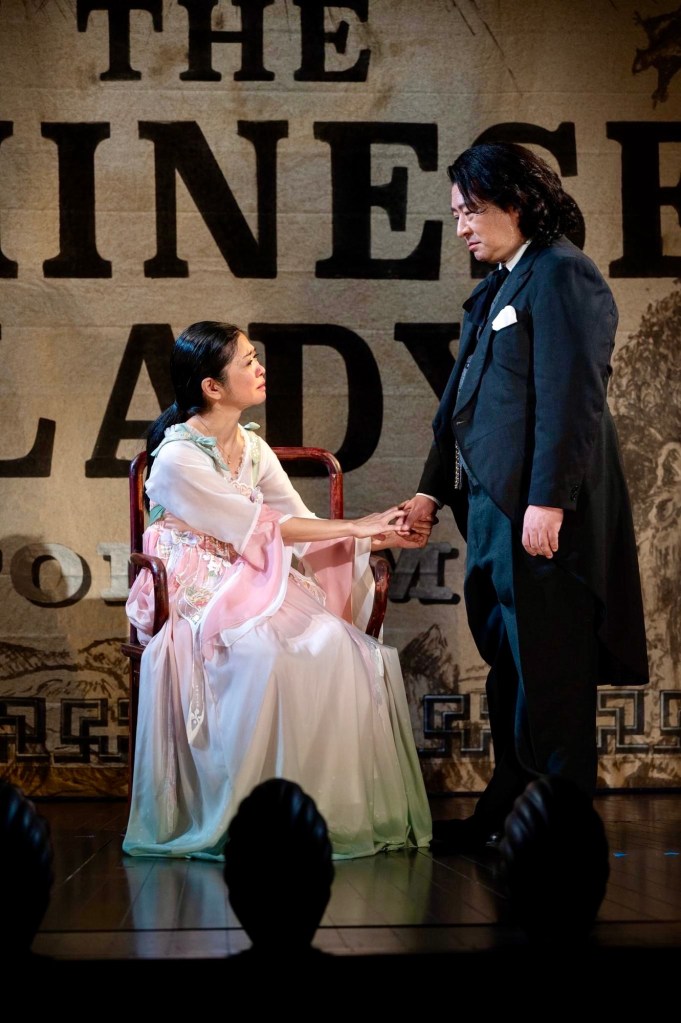
There are two great reasons to see this show: Keiko Agena and Rex Lee. Both are amazing screen actors, and it is a treat to see them together live on stage. The Hertz is the perfect venue for such an intimate show, which chronicles the life of Afong Moy, believed to be the first Chinese woman who ever set foot on American soil 190 years ago in 1824. I’ve included this video about her life from the New York Historical Society.
Not only is The Chinese Lady an intimate portrait of Afong Moy, it is a much needed history lesson of Chinese and Asian Americans and their struggles. Playwrite Lloyd Suh captures the essence of the Afong Moy and ties her story to the historical atrocities the United States has levied against the Chinese throughout history. The play chronicles the Chinese immigrants’ contributions to the American Gold Rush and subsequent building of the Transcontinental Railroad. It goes on to highlight the Chinese Exclusion Act, which may have been partly prompted by the display of Afong’s bound feet. Americans felt foot-binding was a cruel practice, and as a result saw the Chinese people as barbaric. The Opium Wars were also a catalyst, where Great Britain illegally exported Opium into China. Finally, sentiments in California toward Chinese immigrants caused Americans to look at them as inferior. The Chinese Exclusion Act was in place from 1882 to 1943, with limited visas being granted to Chinese immigrants for many years even after it had been repealed.

Today, the people of the US are still wary of the Chinese. We might embrace and have romantic notions of Chinese culture–the food, the traditional dress, a visit to Chinatown in New York, Chicago, or San Francisco, but as a collective we are wary of the Chinese. We are given mixed messages by the media–On one hand, we are told the government of Red Communist China is working to take over the Western World. We remember being told the COVID-19 virus originating in the Wuhan province of China happens to also contain a biolab which designs and studies the virus. The pandemic has exacerbated anti-Chinese sentiment in the USA resulting in the devastating Atlanta Spa Shootings, directly targeting Asian women, as well as other hate crimes against Asians across the country.
On the other hand, as a country we have a much needed diplomatic relationship with China. Many of our factories use Chinese labor to produce cheaper goods shipped and sold in America. We also export almost as many goods to China. Our Atlanta Zoo along with other Zoos across the US work directly with China in helping grow the endangered Panda Population. Beginning in 1973 with then Chinese Ambassador George W Bush helped open trade, China and the USA have developed an interdependent relationship economically.
As a result of both sides of the coin, if this were middle school, USA and China would be considered ‘Frenemies’, which causes heinous radical bullies to commit hate crimes against Asians in the guise of protecting Democracy and Freedom. What we should be doing is acknowledging Asians’ contributions to America and embracing every race as a valuable part of what makes our nation a place people want to live.
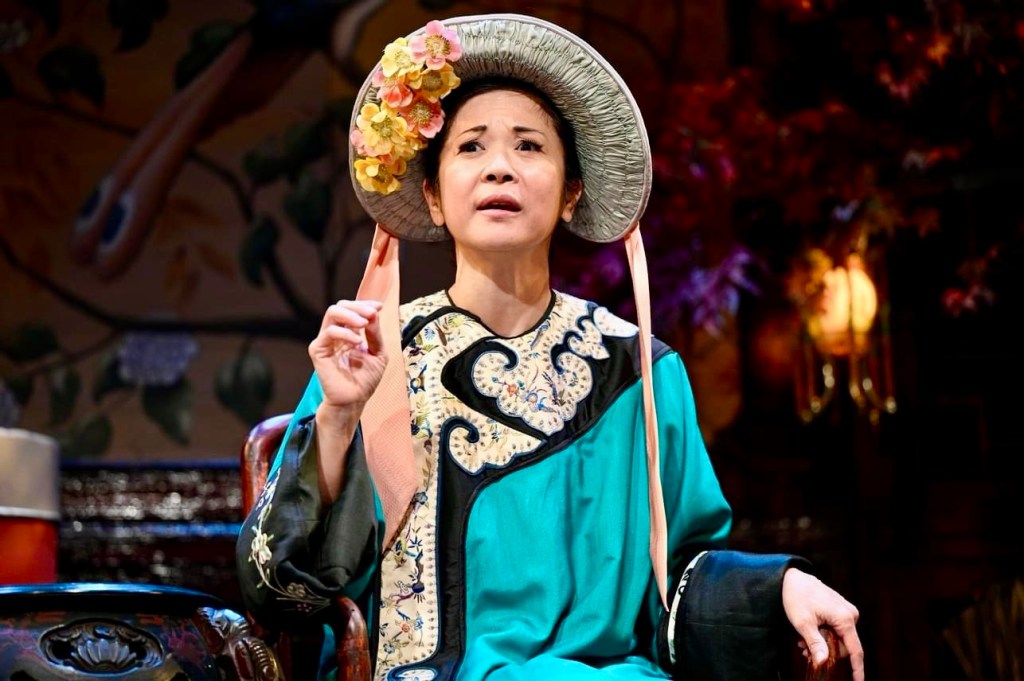
Circling back to the production itself, Keiko Agena is probably best known for her role of Lane in Gilmore Girls, but also has many more film credits on her resume. She’s versatile–a published author of ‘No Mistakes’, an Artist Workbook, and has also worked with improvisation at The Elysian Theater. She gives this performance everything she’s got. It’s simply incredible, and she’s on stage about 98% of the time and has about 80% of the dialogue (these are my estimates, not empirical data). She’s telling a story that spans 204 years–from Afong Moy’s birth to the present–and she tells it to the audience eloquently. In reality, all Afong was expected to do is wear beautiful Chinese costumes, show her feet, walk, and eat with chopsticks. The backstory Keiko tells is a conversation with the audience. It is made clear from the beginning this is an interpretation and representation of Afong Moy’s Life. I can imagine Keiko is both physically and emotionally drained after every telling of this incredible story. There were times where I felt she was looking and talking directly to me, which made the production that much more intimate.

I’ve been a Gilmore Girls fan for years and it’s a guilty pleasure of mine. I’ve probably seen the series about 7 times and the reboot about 4. This is my go-to show when I fall asleep at night. One of my favorite characters is Lane, Rory’s best friend. I love her storyline, her relationship with her mother, her guts and her grit. Keiko played a very convincing 16 year-old when she was 27 as Lane. Today Keiko is 50 years old (I know, hard to believe–right?). She begins THE CHINESE LADY as a very convincing 14 year-old and spans the years until she is in her 70s. Somehow you can see her aging as the curtain closes and opens and time passes. It’s truly incredible.

I’m not as familiar with Rex Lee’s body of work, but he has been in HBO’s Entourage, several ABC shows, and even in Glee. I adored his portrayal of Atung, Afong’s interpreter. They played off each other well, and he provided a levity that was needed for such heavy subject matter. He opens the show with a remote control that continues to accidentally click on stereotypical pop songs about Asians (Little China Girl, Turning Japanese, etc.) until he is able to switch to pre-show announcements. Without speaking in this opening, his facial expressions do the talking. He opens and closes the curtain throughout the show to denote the passage of time. While Afong says Atung is “irrelevant” in the show, he is able to establish Atung’s relevance as he tells his story of his attraction to the white women as well as the white men, and his intimate dreams about Afong. He cares for Afong and wants to protect her until she in turn becomes irrelevant and is replaced by a younger model.
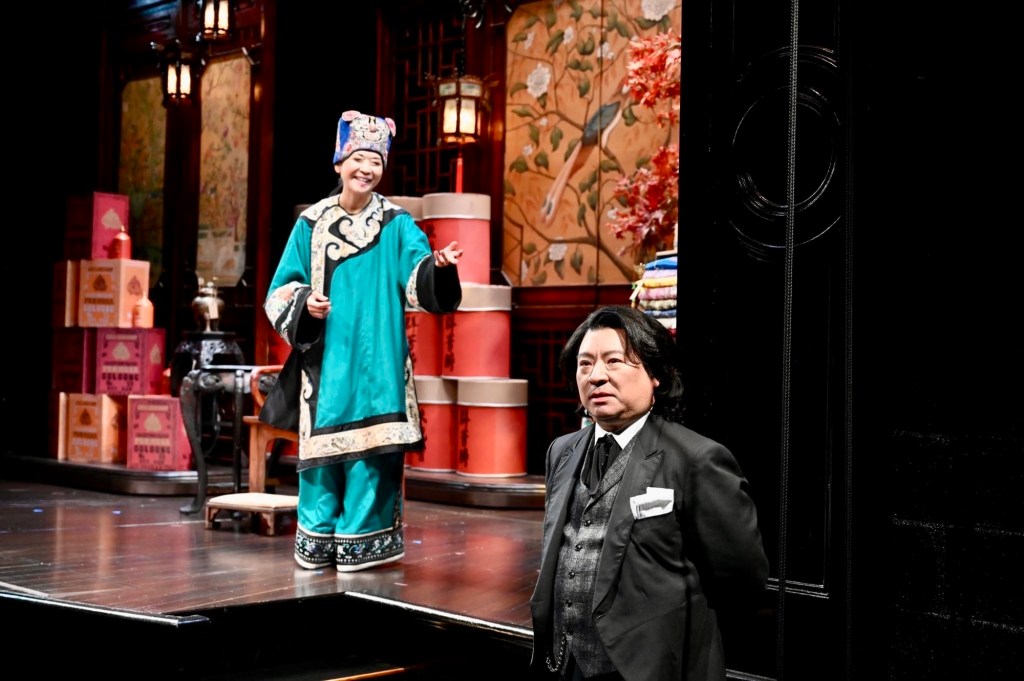
Another ‘character’ in the show is created by the scenic design of Se Hyun Oh, a South Koren set designer based in NYC. Together with costume designer/cultural consultant Hahnji Jang, the set and costumes are a recreation of the shop of Chinese fine goods that featured Afong as an oddity. Each beautiful set piece is adorned with a price tag, denoting that every object in the store is for sale. There are sliding set pieces that reveal different layouts for the shop over time. In the end, all the set pieces are stripped away as Afong’s story becomes an imagining of her life after 1851, where there are no records of her life, but where she continues to tell the story of he effects of the Chinese Exclusion Act.
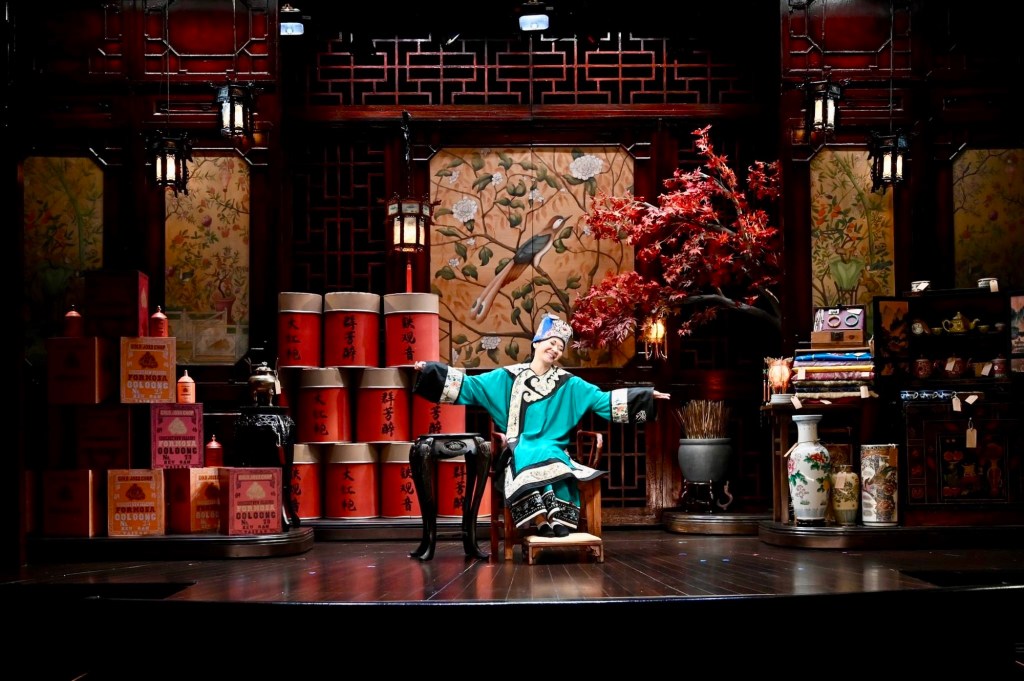
The lights and sound for this show were spot-on and tuned into the heart of the show. The natural lighting helped highlight the fact that this was meant to be a conversation with the audience.
I especially loved the music box that Afong turned on whenever she was eating. The pre-show and transition music choices added the appropriate hint of sarcasm to the show.

While I consider myself a history buff, I was very unaware of this history presented by THE CHINESE LADY. This show is a beautiful tribute to a race of people who have been integral in the shaping of the USA, yet treated as second-class citizens in America for far too long. As I left the theater, I heard the conversation that sparked among patrons: from the theater to the elevator; a group on the street; and a couple behind me as I walked to my car. I had a conversation in my head on the way home, and find myself researching and wanting to know more. Everyone needs to see this show and keep those conversations going.
 Speakeysie