
By: Jody Tuso-Key
Photo Credit: Brody Young
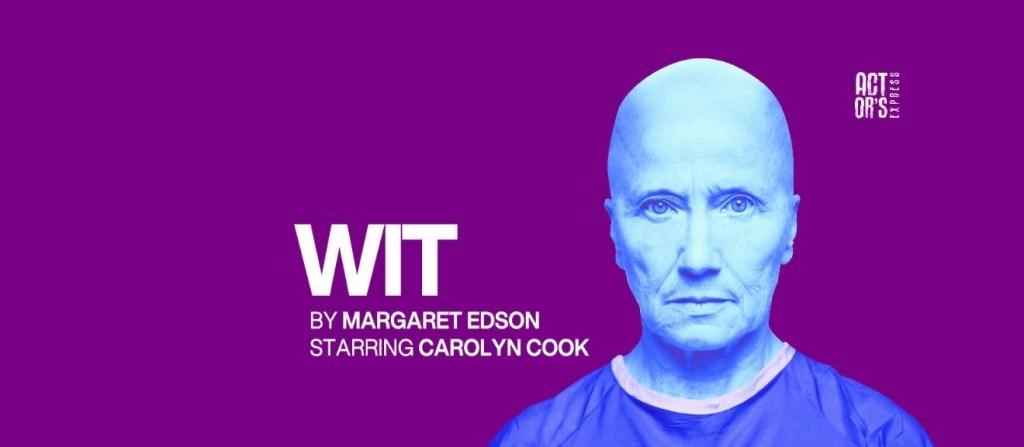
Margaret Edson’s Pulitzer Prize-winning WIT has arrived at Actor’s Express, and plays through June 28th. If you’ve ever wanted to spend two hours laughing at death, crying about life, and reconsidering every doctor’s appointment you’ve ever had, this is the show for you.
In this production, WIT refers both to intelligence and to the use of humor in the face of adversity. The title reflects Vivian Bearing’s sharp intellect as a renowned scholar, but the play ultimately explores how intellectual brilliance alone is not enough to navigate suffering and mortality.
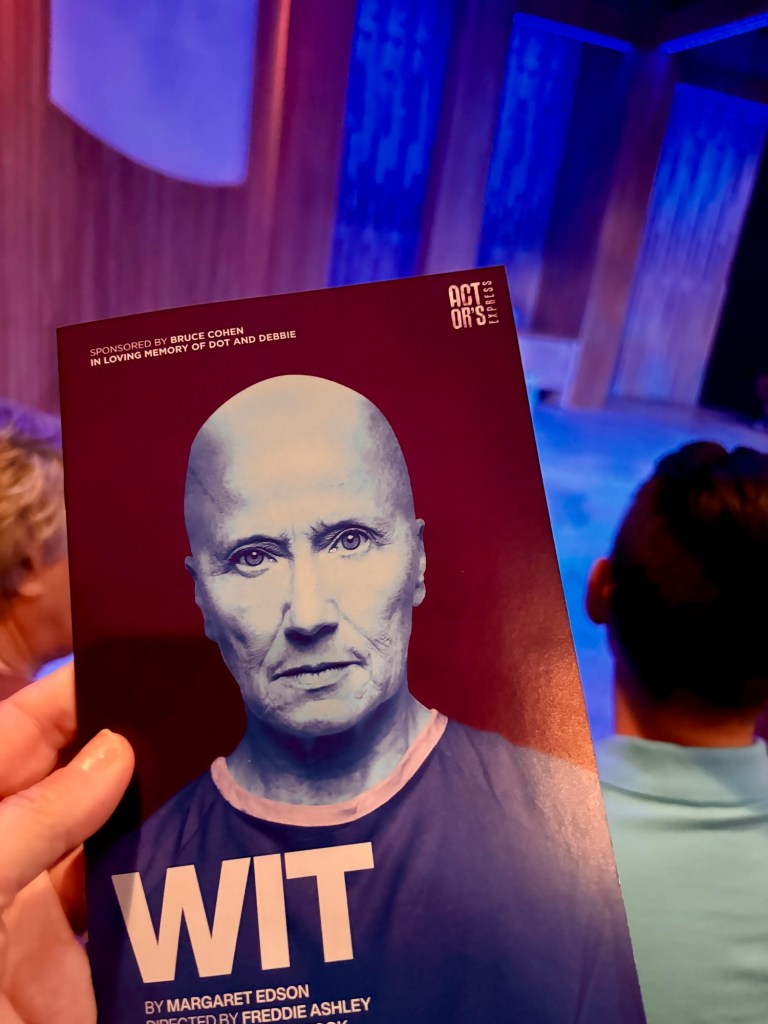
At first glance, Dr. Vivian Bearing appears to be the smartest person in any room she enters—and she knows it. Celebrated scholar of John Donne’s Holy Sonnets, Vivian can dissect a sonnet with the precision of a surgeon and deliver a literary critique sharp enough to require stitches. Unfortunately, when she is diagnosed with Stage IV metastatic ovarian cancer, she discovers that even a world-class intellect can’t talk its way out of a hospital gown.
What follows is less a battle against cancer and more an examination of what happens when a woman who has spent her life analyzing every word is forced to confront the one thing that cannot be footnoted, peer-reviewed, or revised.
Director Freddie Ashley wisely understands that WIT works best when it doesn’t wallow. Instead, he embraces the play’s surprising humor. And there is plenty of it. Hospital life becomes its own absurd comedy where residents speak fluent acronyms; research protocols seem to have more bedside manner than some physicians, and every new procedure sounds suspiciously like something invented by a medieval torturer with a medical degree.
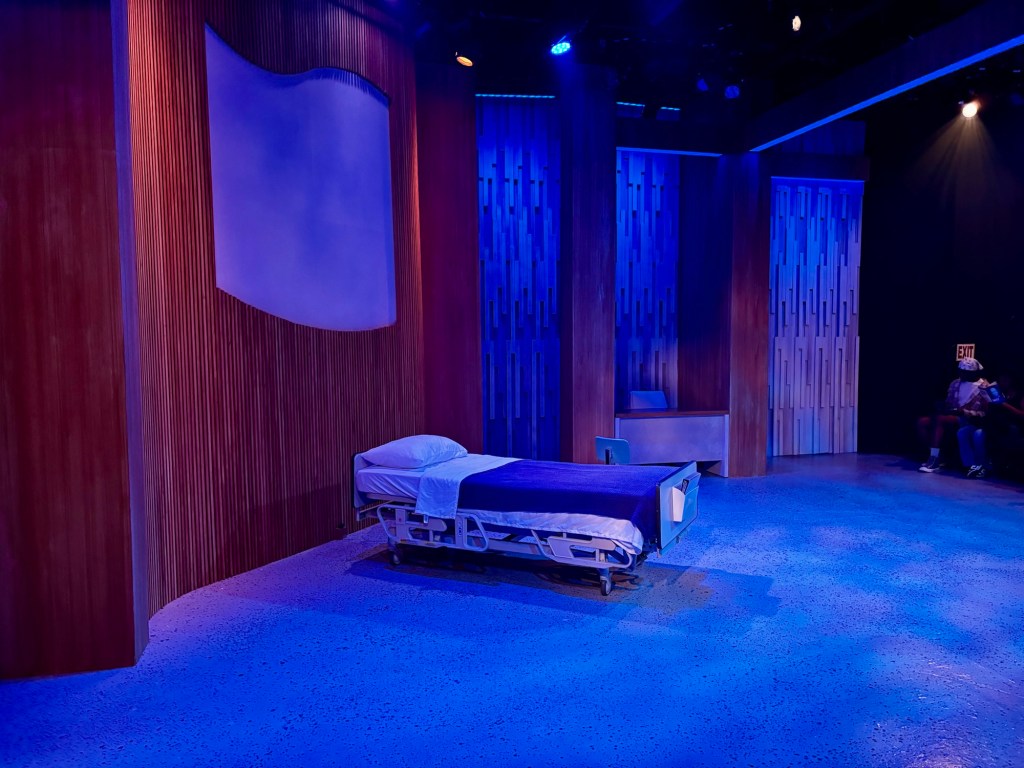
Scenic Designer Jess Ford elegantly balances sterility and humanity, transforming the stage into a space that feels part hospital room, part lecture hall, and part cathedral. Warm wooden panels tower over a lone hospital bed, whose isolation underscores Vivian Bearing’s deeply personal journey through illness. Bathed in cool blue lighting, the minimalist design evokes both clinical precision and quiet transcendence, creating a visually striking environment where medicine, memory, intellect, and mortality collide.
Lighting Designer Mike Morlin brilliantly shifts between the cold efficiency of a hospital and the ethereal beauty of a soul in transition. At times, the stage is bathed in the harsh, clinical glow of examination rooms and treatment centers; at others, it feels almost heavenly, illuminating moments of reflection and revelation. One particularly striking sequence transforms the stage into a living MRI machine as Vivian’s hospital bed glides through various positions while beams of light sweep across the space, replicating scans and X-rays. The effect is both visually stunning and emotionally unsettling, placing the audience inside the machinery of modern medicine while reminding us of the vulnerable human being at its center.
Sound Designer Charles Bedell works with the precision of a hospital monitor, subtly shaping the audience’s emotions without overwhelming them. Medical sounds, hospital ambience, and restrained musical underscoring create an atmosphere that shifts between clinical unease and unexpected tenderness. Like Vivian’s journey, the soundscape moves between the mechanical realities of treatment and deeply human moments. Whether highlighting a diagnosis, a moment of reflection, or the isolation of a hospital room, it reminds us that every beep, buzz, and silence carries meaning.
Costume Designer Nicole Clockel embraces contemporary realism, grounding the production in a world that feels immediate and recognizable. Shades of blue dominate the palette, appearing in Vivian’s hospital gown and the medical staff’s scrubs, reinforcing the sterile, institutional environment that increasingly defines her existence. Standing apart is Susie Monahan, R.N., whose burgundy scrubs subtly but effectively distinguish her from Dr. Kelekian’s army of researchers and clinicians. The choice visually underscores what the script makes clear: while others often see Vivian as a patient, a protocol, or a research opportunity, Susie sees a person
The production finds laughter in all the right places—not by making light of cancer, but by recognizing the strange, sometimes ridiculous reality of being human in the face of it. Anyone who has ever spent time in a hospital will recognize the parade of forms, tests, specialists, and well-meaning professionals who enter your room with alarming enthusiasm while discussing things you’d rather not hear before lunch.
Yet beneath the humor lies profound compassion. Edson’s script quietly asks whether kindness might matter more than credentials, whether human connection outweighs accomplishment, and whether a warm hand can sometimes offer more comfort than the most brilliant diagnosis. The answer arrives not with the force of a medical breakthrough but with the gentleness of a nurse adjusting a blanket.
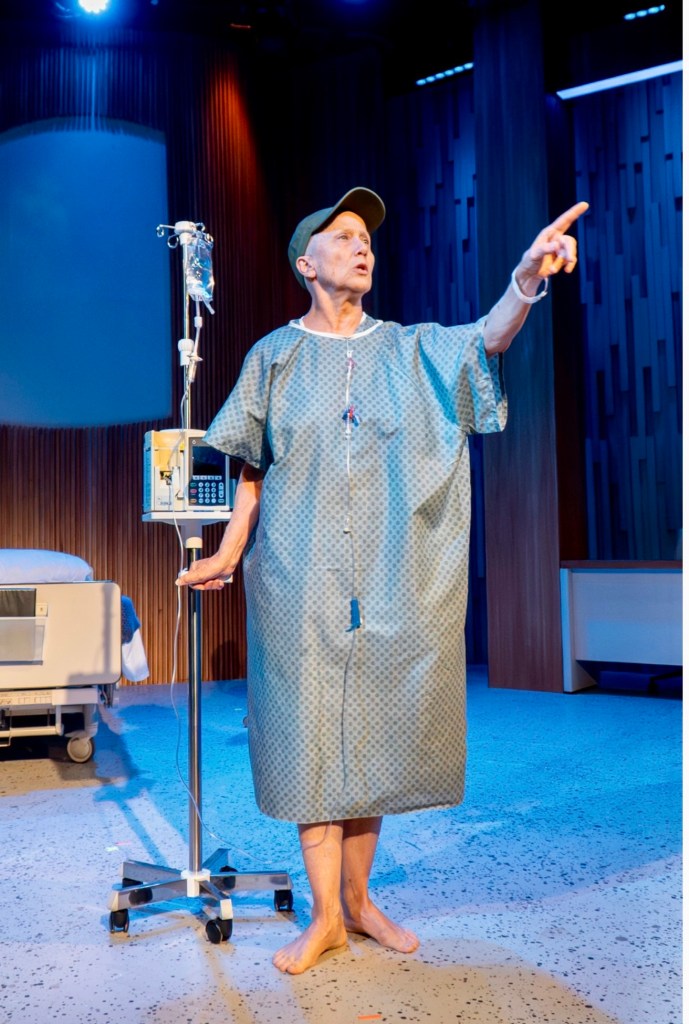
DR. VIVIAN BEARING-Carolyn Cook
Vivian is a professor, scholar, and reigning heavyweight champion of intimidating vocabulary. She has spent her life dissecting the dense, intellectually acrobatic poetry of John Donne with surgical precision, keeping the messy business of human emotion safely footnoted and at arm’s length. But when she’s diagnosed with Stage IV metastatic ovarian cancer, Vivian finds herself enrolled in a crash course no academic preparation could have anticipated. Armed with razor-sharp wit, stubborn independence, and enough sarcasm to sterilize an operating room, she navigates a world of hospital gowns, IV poles, and medical jargon. As her body weakens, Vivian discovers that kindness, connection, and vulnerability may be more valuable than all the scholarly accolades lining her CV.
Carolyn Cook delivers a masterclass as Vivian. She captures every facet of the character: the brilliance, the arrogance, the humor, and the growing vulnerability beneath the academic armor. One moment she’s skewering her students with the efficiency of a seasoned professor during finals week; the next she’s navigating a healthcare system where patients are occasionally treated like particularly interesting science projects. Cook’s performance is so captivating that audiences willingly follow her through chemotherapy, medical jargon, and existential dread without ever wanting to look away.
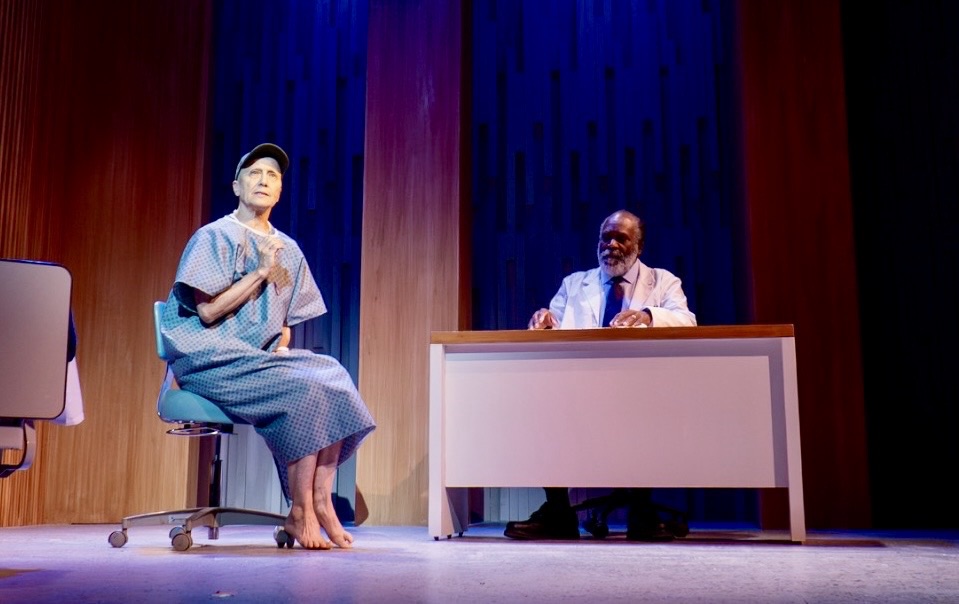
DR. HARVEY KELEKIAN-Rob Cleveland
The physician who delivers life-changing news with the confidence and bedside manner of a man discussing the weather forecast. Brilliant, respected, and deeply committed to advancing cancer research, Dr. Kelekian genuinely cares about his patients—he just occasionally lets science take the wheel while humanity rides in the trunk. He sees Vivian as both a patient and a promising participant in an aggressive treatment protocol, embodying the complicated intersection of medicine’s noble intentions and its clinical detachment.
Rob Cleveland delivers a scalpel-sharp performance as Dr. Kelekian, a brilliant oncologist whose focus on treating the disease often eclipses the patient. With clipped delivery and the bedside warmth of a medical journal, Cleveland perfectly captures a physician shaped by a system that prizes research, results, and clinical trials above human connection. To his credit, he never turns Kelekian into a cartoon villain. Instead, he presents a complex man whose emotional detachment is far more unsettling because it feels so believable.

DR. JASON POSNER- Dane Troy
Once Vivian’s eager student, Jason has grown into a talented young researcher who approaches medicine the same way Vivian approached literature: as an intellectual puzzle begging to be solved. Unfortunately, people are considerably messier than poetry. Armed with impressive credentials and emotional maturity that still has a few semesters left to complete, Jason treats cancer like an opponent to defeat and patients like fascinating case studies. Watching him interact with Vivian is like seeing two mirrors face each other—brilliant minds reflecting the strengths and shortcomings of a life devoted to intellect.
Dane Troy delivers a standout performance as Dr. Jason Posner, Vivian’s former student turned clinical fellow. Having enjoyed his work in numerous Atlanta productions, it’s no surprise that Troy excels here. His towering frame allows him to literally loom over Vivian like an overgrown lab coat, reinforcing the widening gap between doctor and patient. Troy deftly pivots between the star-struck former student eager for his professor’s approval and the research-driven physician who sees her increasingly as data rather than a person. The result is both darkly funny and deeply unsettling.
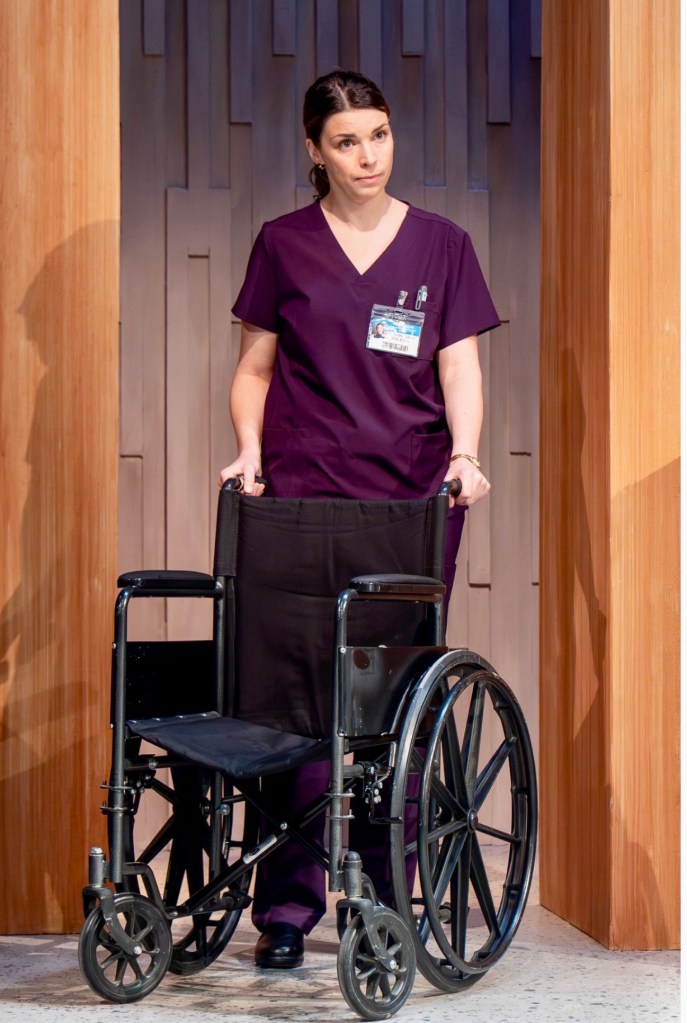
SUSID MONANAN, R.N.-Sarah Elizabeth Wallis
If compassion had a staff ID badge, it would belong to Susie. Practical, funny, and refreshingly allergic to pretension, she provides the warmth and honesty that often gets lost in the fluorescent glow of hospital corridors. While doctors discuss protocols, data, and treatment plans, Susie remembers that the person attached to the IV drip is still a person. She becomes Vivian’s fiercest advocate, translator, confidante, and occasional reality check, proving that genuine human connection can be every bit as healing as medicine.
Sarah Elizabeth Wallis is the emotional lifeline of the production as Susie Monahan, RN. While the doctors debate protocols, research, and test results, Susie is the one person who remembers there is an actual human being in the hospital bed. Young, compassionate, and wise beyond her years, Wallis radiates warmth, empathy and compassion without ever veering into overt sentimentality. She feels like an amalgamation of every exceptional nurse I’ve encountered, including the nurse who helped my family usher my father into his next great adventure. In a world of clinical charts and detached diagnoses, Susie is the pulse, the heart, and the soul of the play, and Wallis delivers a performance that is as comforting as it is unforgettable.
E.M. ASHFORD-Kim Ostrenko
Part mentor, part literary fairy godmother, Professor Ashford is the teacher who first ignited Vivian’s love of language and scholarship. Sharp, wise, and possessing the rare ability to cut through nonsense with surgical precision, Ashford represents the best of academia: intellectual rigor paired with genuine humanity. Her presence reminds Vivian—and the audience—that knowledge without compassion is an incomplete education.
Kim Ostrenko makes a memorable Actors Express debut as E.M. Ashford, the razor-sharp professor who pushes Vivian to look beyond the words and into the soul of Donne’s poetry. Stern, exacting, and allergic to intellectual shortcuts, Ashford is a formidable mentor. Yet Ostrenko beautifully reveals the warmth beneath the tweed. In one of the play’s most touching moments, she trades literary criticism for compassion, climbing into Vivian’s hospital bed to read a children’s book. The shift from demanding professor to nurturing mother figure is both surprising and deeply moving. I hope this is the first of many Atlanta appearances for Ostrenko.
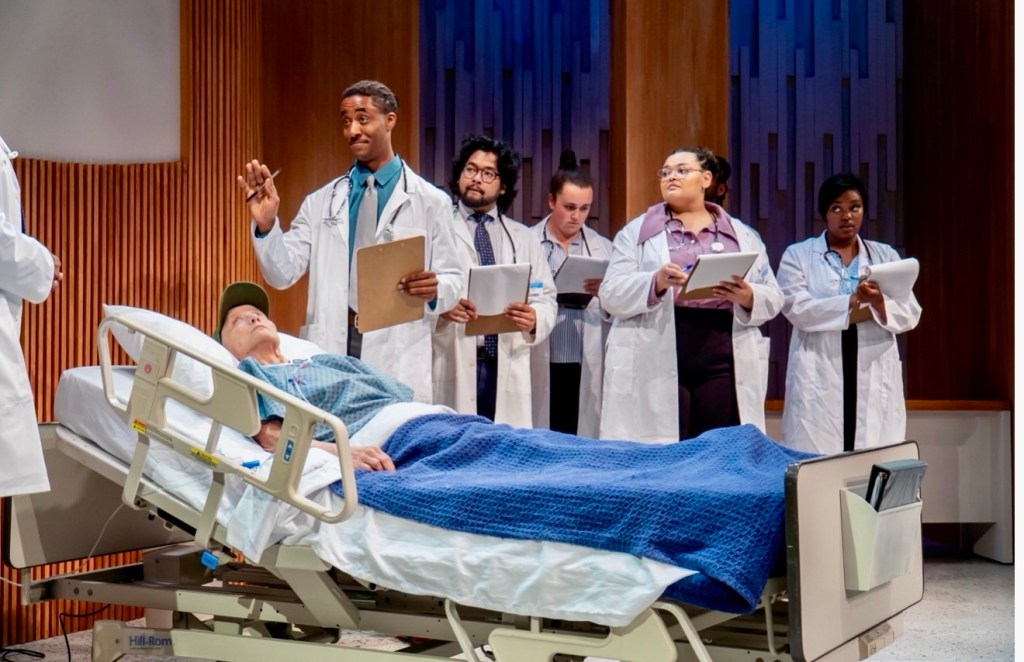
SUPPORTING CAST-In addition to all this incredible talent, the supporting cast of Wit performs theatrical triage, seamlessly shifting between doctors, nurses, technicians, students, and the countless faces that drift through the sterile ecosystem of a hospital. One moment, they’re discussing treatment protocols with clinical precision; the next, they’re wheeling equipment, delivering difficult news, or simply occupying the background hum of a place where life, death, hope, and exhaustion share the same fluorescent lighting. Their transitions are as smooth as a well-practiced hospital shift change, creating a world that feels both authentic and unsettlingly familiar. Together, they remind us that while Vivian’s journey is deeply personal, it unfolds within a system populated by people who are each carrying their own burdens, blind spots, and moments of grace. Their collective work transforms the stage into a living, breathing hospital where every interaction matters and every heartbeat counts.
As a writer, I particularly appreciated the play’s discourse surrounding John Donne’s poetry and the power of punctuation. Early in her academic career, Vivian’s mentor, E.M. Ashford, has her rewrite a paper after discovering she had relied on an edition that included excessive punctuation. Ashford argues that where an emphatic exclamation point insists upon meaning, a simple comma allows for greater nuance and ambiguity—especially in Donne’s contemplation of death. Young Vivian dutifully embraces her professor’s scholarly rigor. Yet as she approaches her own mortality, dying Vivian returns to the version with the “wrong” punctuation. In one of the play’s most moving moments, she ultimately finds comfort not in academic precision, but in the emotional truth contained within those extra marks. It’s a subtle but powerful reminder that when confronted with death, humanity often matters more than intellectual correctness.
Actor’s Express has long been known for producing intelligent theatre, but WIT may be one of its most deeply human productions yet. This production is funny, heartbreaking, thought-provoking, and deeply moving. It reminds us that life is precious, that death is inevitable, and that if you’re going to spend time in a hospital, it’s probably best to find a sense of humor somewhere between the IV pole and the oncology ward.
By the final moments, there isn’t a dry eye in the house. Not because the play manipulates emotions, but because it earns them honestly. Like the best doctors, WIT tells the truth, even when it hurts. And like the best medicine, it leaves you feeling changed.
On a personal note, WIT resonated with me deeply. Having lost my father to cancer and with a family member currently battling ovarian cancer, Vivian’s journey brought back difficult memories but also offered comfort. Rather than dwelling on loss, Wit celebrates dignity, humor, resilience, and humanity. I laughed, I cried, and somewhere in between, I found a measure of peace.
Consider this your official prescription: see WIT at Actor’s Express. Do it to honor those you know and love who have battled this horrific beast. Side effects may include laughter, tears, philosophical reflection, and an overwhelming urge to call someone you love. This show is sure to sell out, so get your tickets, stat, before they are no more.
As always, peace be with you, and thanks for your readership

